
Advancing Empowerment Through Advocacy
We’re publishing a series of articles each month about the tenets of the NADSP Code of Ethics, which serve as a straightforward and relevant guide for direct support professionals (DSPs). It helps them resolve the ethical dilemmas they face every day and encourages them to achieve the highest ideals of the profession. This edition covers the tenet ‘Advocacy.’
Inside The Tenet: Advocacy
The Advocacy tenet of the Code of Ethics centers on the responsibility of direct support professionals to stand side-by-side with the people they support in promoting fairness, opportunity, and full community participation. Advocacy is not about speaking for someone in place of their voice. It is about empowering people to speak for themselves while ensuring their rights, choices, and dignity are respected in every context.
Advocacy emphasizes that direct support professionals play a critical role in helping those they support to navigate systems, access resources, and challenge barriers that limit inclusion. It expands beyond a focus of individual support to include broader systems advocacy, laws, regulations, policies, and procedures that promote and honor the direct support profession.
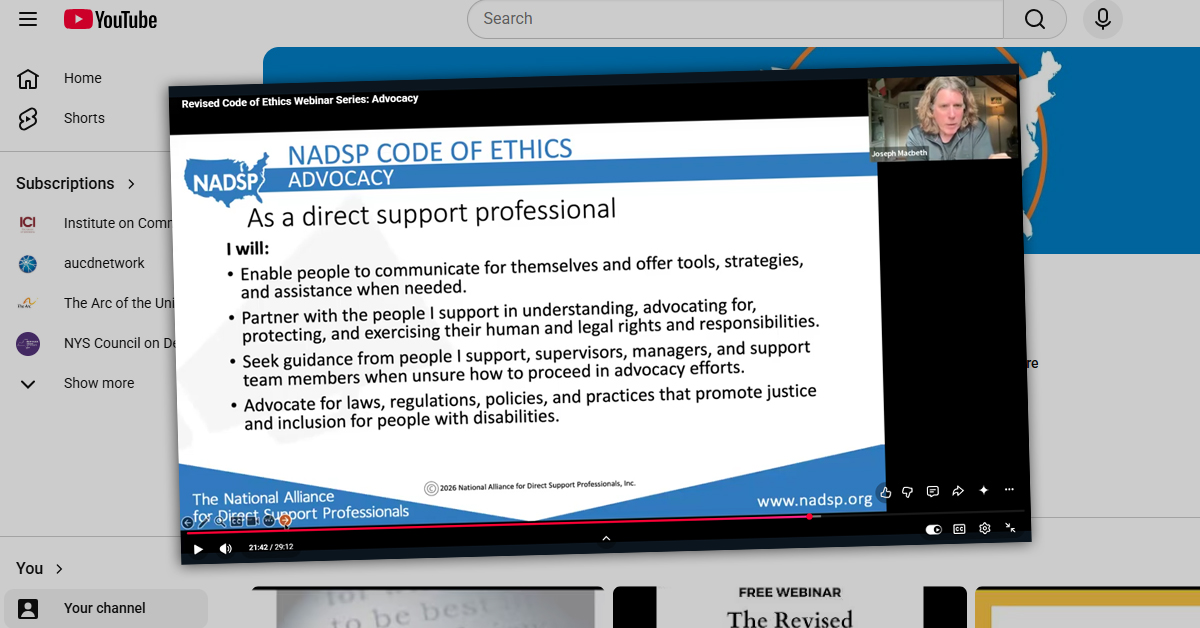
Tenet Video: Advocacy
This short video covers the NADSP Code of Ethics tenet ‘Advocacy.’ NADSP has produced videos about all of the Code of Ethics tenets, which are available through our YouTube playlist. We have also created a version that shares audio descriptions of the content, as well as a version with ASL interpretation.
The Impact On People Receiving Services
By embracing and implementing the Advocacy tenet, you can significantly enhance the lives of people receiving services by promoting empowerment, rights, and inclusion. The tenet ensures that people are supported in expressing their own choices and making decisions about their lives, rather than having decisions made for them. Through advocacy, people gain a better understanding of their rights and are protected from discrimination or mistreatment.
This leads to a highly person-centered approach that is built on trust and partnership. Additionally, advocacy helps remove barriers to community participation, increasing opportunities for employment, relationships, and social involvement. At a broader level, it contributes to improved systems and policies that better support people with disabilities. Overall, the tenet transforms support into a collaborative process that fosters decision-making, dignity, and community participation.
Applying The Tenet In Daily Supports And Services
Direct support professionals can apply the Advocacy tenet in their daily work by consistently prioritizing the voice and choices of the people they support. This includes encouraging individuals to express their preferences and providing communication tools or support when needed. direct support professionals should always stay informed about the human and civil rights of people with disabilities and actively help people understand and exercise those rights. direct support professionals should always be looking to promote a person’s advocacy skills in everyday situations, such as medical appointments where clinicians may not be speaking directly to the person, service planning meetings where other professionals might be making decisions for a person, or community activities where there might be accessibility issues.
In many situations, direct support professionals can model respectful partnership and ensure the person’s perspective is heard and central to the discussion. When ethical challenges arise, direct support professionals should collaborate with the person and may need to seek guidance from other team members to determine the best course of action.
Additionally, direct support professionals should advocate beyond these daily interactions by supporting inclusive practices in their organizations and communities. There are also opportunities for direct support professionals to advocate and speak on behalf of their profession by sharing examples of successful outcomes they have helped people with disabilities achieve, as well as the challenges that often come with being a direct support professional.
Ethical Dilemma: An Example Involving ‘Advocacy’
One common ethical dilemma in advocacy may be when a person we support makes a choice that other team members might believe to be unsafe. A good example that frequently happens in direct support is when a person receiving services wants to spend time with someone that team members distrust and feel might have bad intentions. A direct support professional might feel torn between respecting the person’s autonomy and ensuring their safety.
Always Advocate WITH, not FOR. When using the Advocacy tenet of the Code of Ethics, the direct support professional should prioritize the individual’s voice while still addressing potential risks and consider outcomes. This can include helping the person clearly communicate their choice, exploring consequences together, and offering strategies to stay safe. The direct support professional can also involve others from the support team – with the individual’s consent – to gather perspectives and identify reasonable solutions. Rather than making the decision for the person, or saying “no,” the direct support professional stands alongside the person, ensuring that their rights are respected while thoughtfully supporting informed decision-making and growth.
Tenet Tips For ‘Advocacy’
-
- Always advocate WITH the person you support. Don’t advocate FOR.
- Everyone, regardless of their disability, can advocate.
- Always listen carefully to the persons preferences, choices, and reasons for making a decision.
- If a person doesn’t communicates using their speaking voice, find alternative methods to help them express themselves.
- Help find ways to build skills that help people speak up for themselves.
- Be active in your own advocacy and participate in activities that promotes the direct support profession.
- Always speak up when you see systemic exclusion or unfair treatment.
- We must always promote choice, offer options, and respect the person’s decisions, even when they differ from our own views.
- Always be sure to document and follow through to ensure any concerns are communicated with other team members.
- To quote the late, great Dave Hingsburger, “Be a person’s microphone, not their voice!”
Additional Resources For ‘Advocacy’
- NADSP: Advocacy & Policy Updates
- Frontline Initiative: Choice, Direction, and Control
- NADSP: Competency Article About Advocacy
- The Arc: Self-Advocacy Information
- SARTAC: Organizational Advocacy Resources
- TASH: Advocacy Tools
- Frontline Initiative: Legislative Advocacy
- ASAN: Advocacy Resources
- Impact: Self-Advocacy
- Frontline Initiative: Self-Determination
NADSP CODE OF ETHICS GUIDE
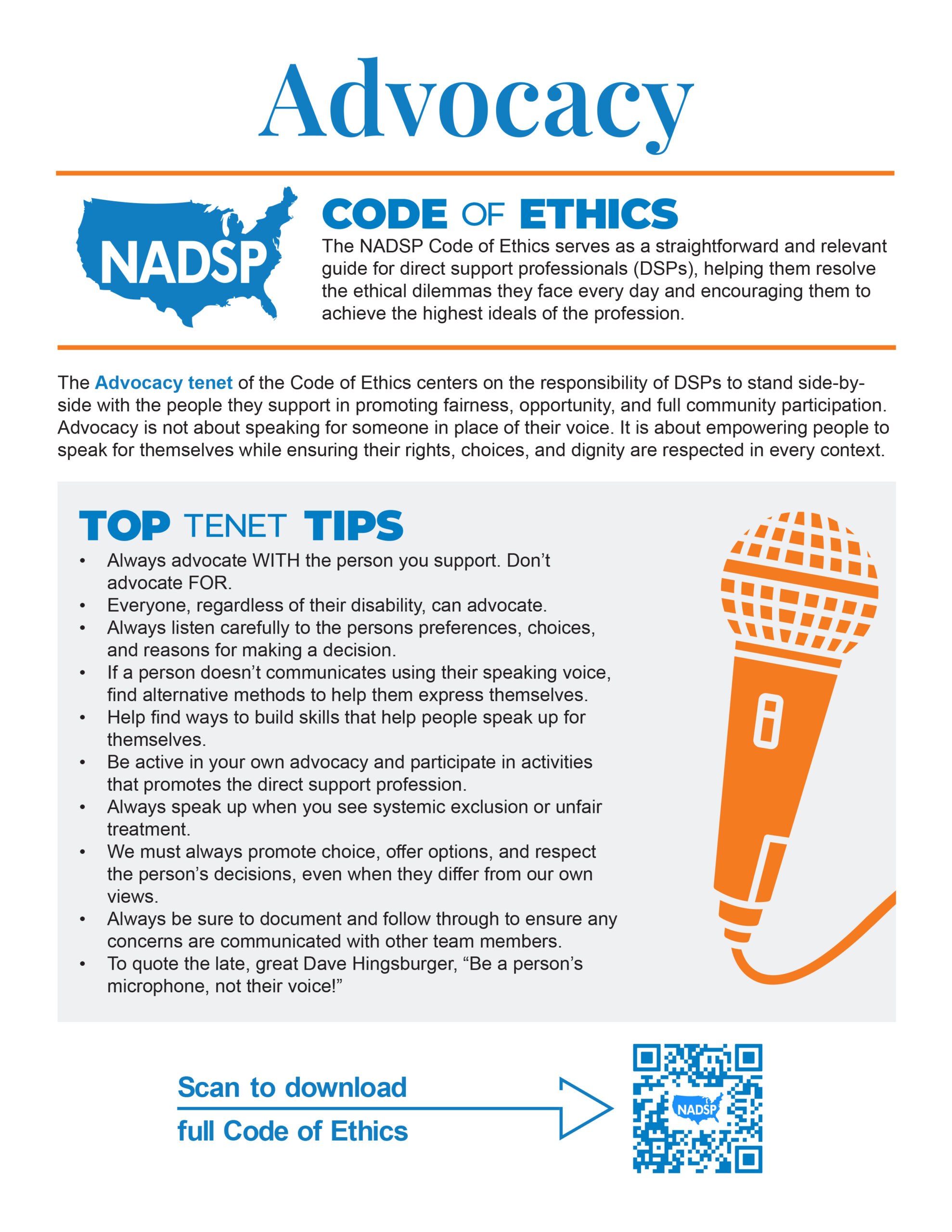
Tenet 1-Page Guide: Advocacy
This free 1-page guide shares an overview of the NADSP Code of Ethics tenet ‘Advocacy.’ It includes general information about the tool, the tenet, and tips for applying it in your daily work. Organizations and professionals are encouraged to print out the guide and share it with others.
NADSP CODE OF ETHICS WEBINAR
Tenet Webinar: Advocacy
This 30-minute webinar recording shares practical tips, real-world examples, and ethical dilemmas related to the NADSP Code of Ethics tenet, Advocacy. In this session, you’ll learn more about this tenet and how you can embrace it in your daily supports and services.
NADSP Code of Ethics
The NADSP Code of Ethics serve as a straightforward and relevant guide for direct support professionals (DSPs), helping them resolve the ethical dilemmas they face every day and encouraging them to achieve the highest ideals of the profession.
Additional NADSP Code of Ethics Resources

Putting Person-Centered Supports Into Action

Foundations Of Justice, Fairness, Equity, and Inclusion

Maintaining Confidentiality and Privacy