
Foundations Of Justice, Fairness, Equity, and Inclusion
We’re publishing a series of articles each month about the tenets of the NADSP Code of Ethics, which serve as a straightforward and relevant guide for direct support professionals (DSPs). It helps them resolve the ethical dilemmas they face every day and encourages them to achieve the highest ideals of the profession. This edition covers the tenet ‘Justice, Fairness, Equity, and Inclusion.’
Tenet Video: Justice, Fairness, Equity, and Inclusion
This short video covers the NADSP Code of Ethics tenet ‘Justice, Fairness, Equity, and Inclusion.’ NADSP has produced videos about all of the tenets, which are available through our YouTube playlist. We have also created a version that shares audio descriptions of the content, as well as a version with ASL interpretation.
Inside: Justice and Fairness
By Kathy Brown, NADSP Regional Manager of E-Badge Academy Operations
The Justice and Fairness part of the tenet demands that we move beyond the role of a passive caregiver and become active advocates. Our first responsibility is to recognize – and educate both the public and the people we support to recognize – that people with disabilities possess the exact same human rights as anyone else. No clause or exception exists that strips a person of their inalienable rights due to a disability. Internalizing this understanding is absolutely critical to effectively supporting and advocating alongside the people we serve.
As professionals, our commitment to justice is demonstrated through daily action: identifying and dismantling barriers, maintaining an awareness of our own biases, and ensuring that the people we support can live meaningful lives with their rights fully recognized.
The Impact: Justice And Fairness
Ensuring Justice and Fairness helps guarantee that the people we support are treated as equal citizens with equal rights. A person’s rights cannot be restricted or revoked simply because they have a disability, live in a group setting, or out of fear that they lack the understanding to protect themselves.
Rights should never be restricted under the guise of being for their “own good.” Restrictive plans – including dietary or community restrictions – must never be implemented arbitrarily. They should only be vetted through a dedicated Human Rights Committee, focused on upholding individual liberties, and every plan must include an intentional strategy to fade out those restrictions.
The people we support deserve to live life on their own terms, with their dignity honored and their rights intact. Because DSPs work most closely with people, they are on the front lines of rights education. Upholding justice and fairness directly empowers those we support to achieve greater independence, integrate into community life, and exercise true autonomy.
Applying The Tenet: Justice And Fairness
DSPs can prioritize rights every single day, whether through small everyday activities, like ensuring privacy during personal care, or on a larger scale, such as partnering with a person to advocate for community accessibility.
To do this effectively, DSPs must practice ongoing self-reflection to keep personal biases in check. We must actively support people to speak up and clear away the physical or administrative barriers that limit community access.
Education is a cornerstone of this tenet. A DSP’s role is to teach people about their rights and provide them with opportunities to explore environments and activities they might not know are available. By introducing new experiences, we give people the information they need to make informed choices about the lives they want to lead.
When we witness a barrier or an unfair restriction, as DSPs, we must act. However, you should not act alone or “go rogue.” Instead, seek out the backing of your supervisor, director, or self-advocates. Speak up, speak out, and support people to self-advocate in whatever way they can. Justice is a right, but it is not always a given; sometimes, we must actively fight to ensure it. Guarding human rights, checking our biases, removing barriers to choice, and teaching self-advocacy is not just a preference, it is a DSP’s ethical obligation.
Ethical Dilemma: Justice And Fairness
In the real world, medical issues are frequently used to justify stripping people of their rights. For most citizens, following medical advice is a choice; when a doctor suggests changes to diet or exercise, a person can choose whether or not to comply. Unfortunately, people with developmental disabilities receiving services are often denied this choice and mandated to follow doctor’s orders. This creates a profound ethical dilemma for DSPs.
Consider the story of Rebecca (a pseudonym), a woman living in a group home who was diagnosed with Prader-Willi Syndrome. This life-threatening condition severely slows metabolism and causes obsessive overeating without ever feeling full. Because of the medical severity, Rebecca had an extensive, human-rights-approved restrictive plan in place to limit her food access, including locked cabinets and refrigerators. Rebecca understood and accepted these boundaries as necessary for her safety.
However, her doctor had also placed her on a strict 900-calorie-per-day diet. Having learned about her rights from her DSPs, Rebecca approached a staff member and stated that she wanted to increase her intake by 200 calories, specifically at dinner. She explained that she understood she might gain weight, but she chose to be a “curvy” person rather than skinny.
The DSP knew the home’s medical staff felt strongly about strict adherence to orders. However, choosing to uphold the NADSP Code of Ethics, the DSP promised to support Rebecca in notifying the medical team and offered to accompany her to her next doctor’s appointment. The DSP also advocated to the Human Rights Committee, securing their backing to move forward.
The advocacy was a success. The doctor listened to Rebecca, understood that her choice was not immediately life-threatening, and officially updated the diet order.
Had Rebecca not been educated about her rights by her DSPs, she might have spent her life battling the system – resorting to foraging for food in garbage cans or grabbing items from strangers in the community. Instead, thanks to an ethically grounded DSP who championed justice and fairness, Rebecca was empowered to live a happy, dignified life on her own terms: healthy, self-determined, and curvy.
Inside: Equity and Inclusion
By Nicole DamaPoleto, NADSP Director of Communication and Programs
Within the tenet of justice, fairness, equity, and inclusion, there is language about the legal aspects of this tenet. But what’s just as important is that direct support professionals must ensure people have opportunities that they desire. People receiving services should be respected and DSPs need to actively find opportunities for integration into a person’s community. Direct support professionals must actively learn about inclusion and teach the people they support that they should be valued, integrated, and respected in their communities.
As mentioned above, in the Justice and Fairness sections, it’s important that DSPs recognize their bias to make sure people feel free to express their own identities. If there are any barriers to expression, a direct sport professional must actively work to provide opportunities and support. As a direct support professional, you should always be looking for opportunities for people to be able to express themselves from their everyday wear to expressing their own beliefs.
The Impact: Equity and Inclusion
A direct support professional can be the support that provides opportunities for a person to live as their true self. If a direct support professional is imposing their own beliefs or bias on a person they’re supporting, it can have a very detrimental impact on someone. Providing opportunities for someone living with a developmental disability to be fully part of communities – be it culturally or identity-based – can improve the quality of a person’s life.
True inclusion can change lives. The way this impacts people receiving services is providing opportunity for people to show up as their whole self. When a quality direct support professional assists and advocates against any barriers, it can create an equitable experience. There is a difference between solely being welcomed, in comparison to a place or community that has been created with you in mind.
Applying The Tenet: Equity and Inclusion
Our industry loves acronyms. I think of the many organizations that go by acronyms including our very own NADSP. It’s a handy way to say a lot of words in a short amount of space. When you are doing your daily work as a direct support professional – or reflecting in a broad picture of how well we are supporting someone’s quality of life – we should always be checking with “JEFI” – Justice, Equity, Fairness, and Inclusion. Yes, the Code lists this is Justice Fairness, Equity, and Inclusion, but this is a handy tip to think of “Jefi” in the scope of supporting someone to lead a life of their choosing.
Here are some questions to consider:
- Is the decision I am making in line with a person’s justice, equity, fairness and inclusion?
- Is what I’m doing aligned with the beliefs of the person I support?
- Are they being integrated within their community?
- Are there any barriers they face in being a part of this community?
- Are there other opportunities for them to participate in their community?
- How do my own biases showing up in my work to support this person?
This is just a handy way for you to think about how you approach your direct support work.
Ethical Dilemma: Equity and Inclusion
An example of an ethical dilemma a direct support professional may come across is working with someone of different beliefs than them. Whether we believe it or not, everyone has bias. Biases can be unconscious attitudes or beliefs that affect your actions and decisions without even realizing it. A direct support professional may be working with someone whose beliefs are significantly different than them. What this means is that if a direct support professional is supporting someone whose beliefs are different than their own, they should not be imposing them on the people they support. The person you’re supporting should direct how they express their beliefs and work with their DSP or help remove any barriers.
In Kathy’s part of the article, she mentions how many people with developmental disabilities are told what to do without choice. The Justice, Fairness, Equity, And Inclusion tenet vehemently puts a direct support professional in alliance and advocacy with the person they’re supporting. Providing services in alliance with this tenet means listening to the person that you’re supporting. It means taking action to connect that person to communities and provide inclusion without barriers.
Another example could be that a direct support professional could have a different hair texture than the person they’re supporting. It’s important for the direct support professional to get to know the person they’re supporting to know how they want to express themselves physically. It might include research for the direct support professional to find the best places for that person to get the corrective hair care as people with a curlier texture require a different kind of conditioning treatment than people with less texture in their hair. Hair is a very important part of our own expression and it’s important that direct support professionals are an alliance with the person they support for them to have the best opportunities possible.
It’s important that DSPs get to know the person they support. One of our team members, Susan Arwood, always says “we’re looking for people to have more than a lifetime of good services, we’re looking for people to have a good life.” Where does that begin? It begins with staying curious about the person you’re supporting. It begins with understanding that we might make mistakes. Communication evolves and we must acknowledge and learn from those mistakes. This can mean setting agreements on how you create opportunities in partnership for the person you support.
Tenet Tips For ‘Justice, Fairness, Equity, and Inclusion’
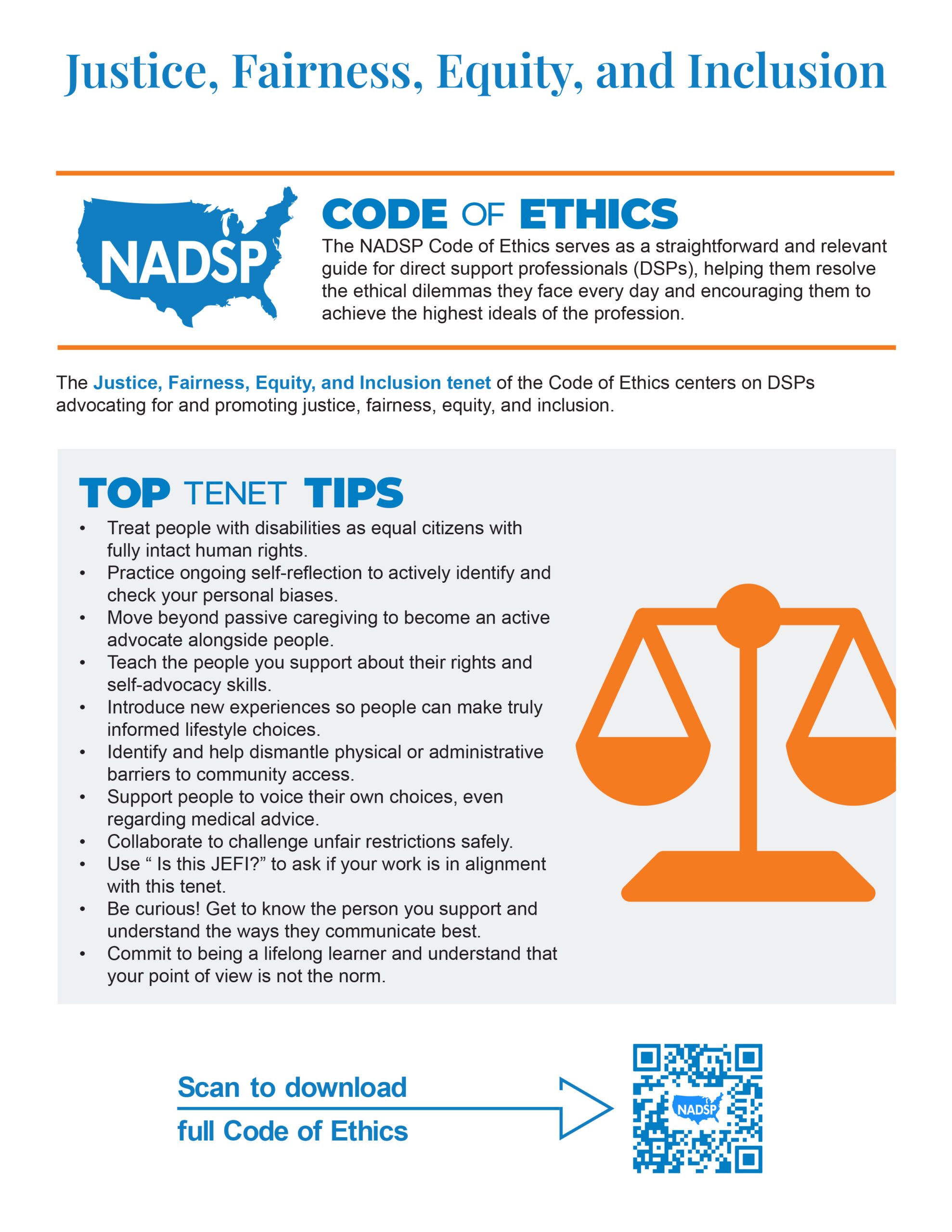
- Treat people with disabilities as equal citizens with fully intact human rights.
- Practice ongoing self-reflection to actively identify and check your personal biases.
- Move beyond passive caregiving to become an active advocate alongside people.
- Teach the people you support about their rights and self-advocacy skills.
- Introduce new experiences so people can make truly informed lifestyle choices.
- Identify and help dismantle physical or administrative barriers to community access.
- Support people to voice their own choices, even regarding medical advice.
- Collaborate to challenge unfair restrictions safely.
- Use “ Is this JEFI?” to ask if your work is in alignment with this tenet.
- Be curious! Get to know the person you support and understand the ways they communicate best.
- Commit to being a lifelong learner and understand that your point of view is not the norm.
Additional Resources For ‘Justice, Fairness, Equity, and Inclusion’

NADSP CODE OF ETHICS GUIDE
Tenet 1-Page Guide: Justice, Fairness, Equity, and Inclusion
This free 1-page guide shares an overview of the NADSP Code of Ethics tenet ‘Justice, Fairness, Equity, and Inclusion.’ It includes general information about the tool, the tenet, and tips for applying it in your daily work. Organizations and professionals are encouraged to print out the guide and share it with others.
NADSP Code of Ethics
The NADSP Code of Ethics serve as a straightforward and relevant guide for direct support professionals (DSPs), helping them resolve the ethical dilemmas they face every day and encouraging them to achieve the highest ideals of the profession.
Additional NADSP Code of Ethics Resources

Maintaining Confidentiality and Privacy
NADSP Code of Ethics: Tenet Webinars
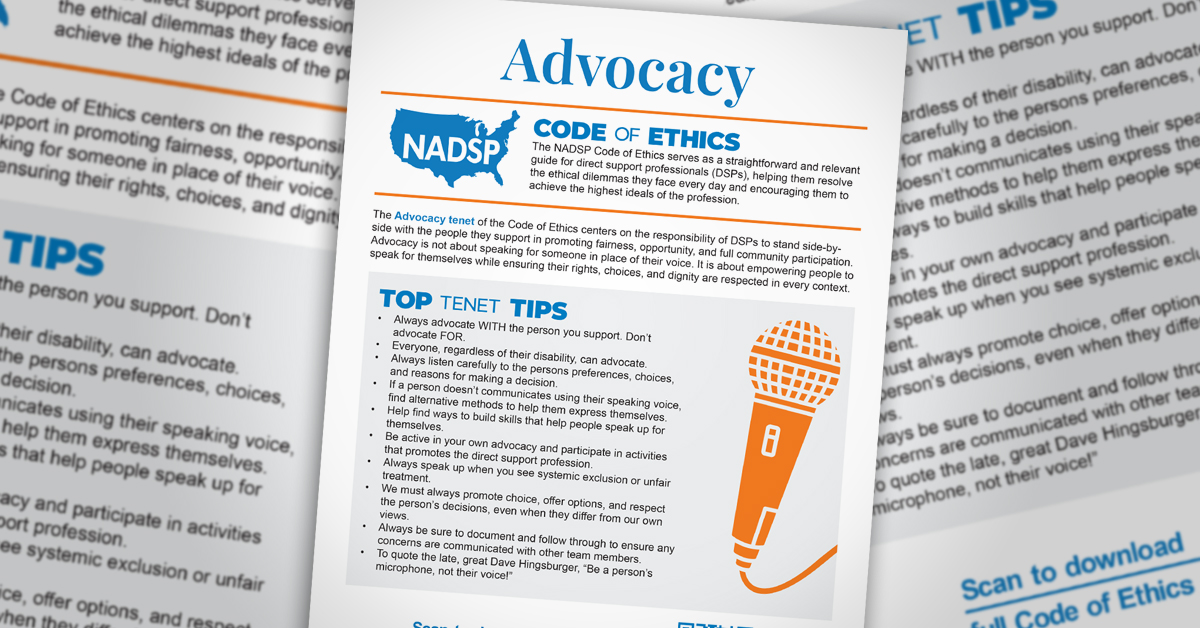
NADSP Code of Ethics: Tenet 1-Page Guides